A 30 Year Mortgage is a Gift

A 30 Year Mortgage is a Gift

If you thought taking out a 15 year mortgage was going to save you money you were SCAMMED!

What if I told you for the same amount of money per month you could have:

  • More Flexibility
  • More Security
  • More Money

Example:

You and your loved ones find a house you LOVE! You need a $200K mortgage to buy the home.

You get the mortgage rate quotes below:

  • 15 Year: 2.50%
  • 30 Year: 3.00%

The 15 year loan SEEMS cheaper, but there is a cost you don’t see! What is it?

For every dollar that you pay into the mortgage you MISS the chance to invest it. This is called Opportunity Cost

So how does this play out?

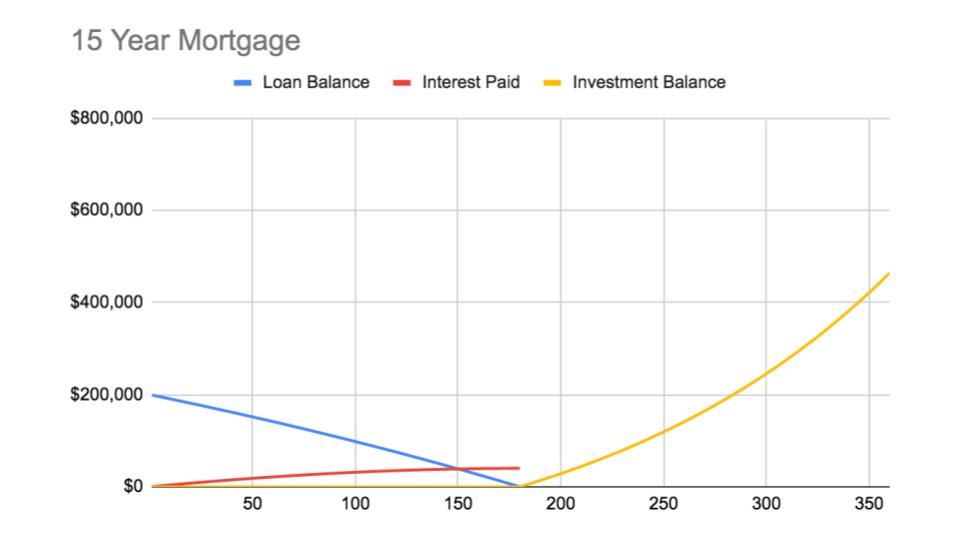
15 Year Mortgage

  • Rate: 2.50%
  • Payment: $1,333
  • Total Interest Paid: $40,622

After you fully pay off the mortgage you invest the payment of $1,333 every month for the next 15 years at an 8% return.

  • Investment Balance: $464,344

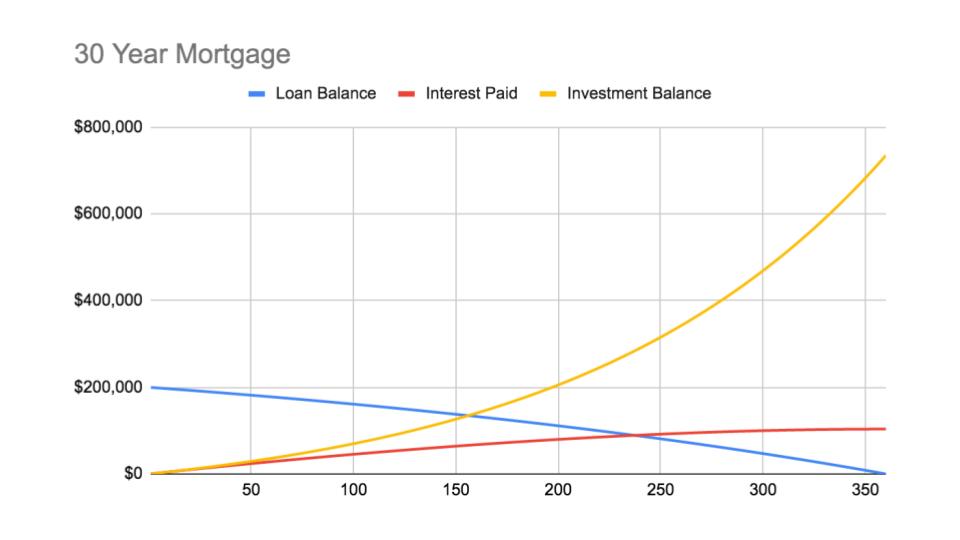
30 Year Mortgage

  • Rate: 3.00%
  • Payment: $843
  • Interest Paid: $103,601

You invest the difference of $490 between the 15 year and 30 year mortgage payment every month for 30 years at an 8% return.

  • Investment Balance: $735,145

Choosing the 30 year mortgage you pay $63,535 in extra interest ($103,601 – $40,066) But gain $270,801 in investments! ($735,145 – $464,344)

A net of $207,265!

The Opportunity Cost of choosing the 15 year mortgage is $207K!

But that is not it!

You gain Flexibility AND Security! If life happens and you:

  • Lose your job
  • Have a decrease in income
  • Become disabled

You will have

  • A payment that is lower by $490/month or $5,880/year
  • Reserves in investments to help pay for it!
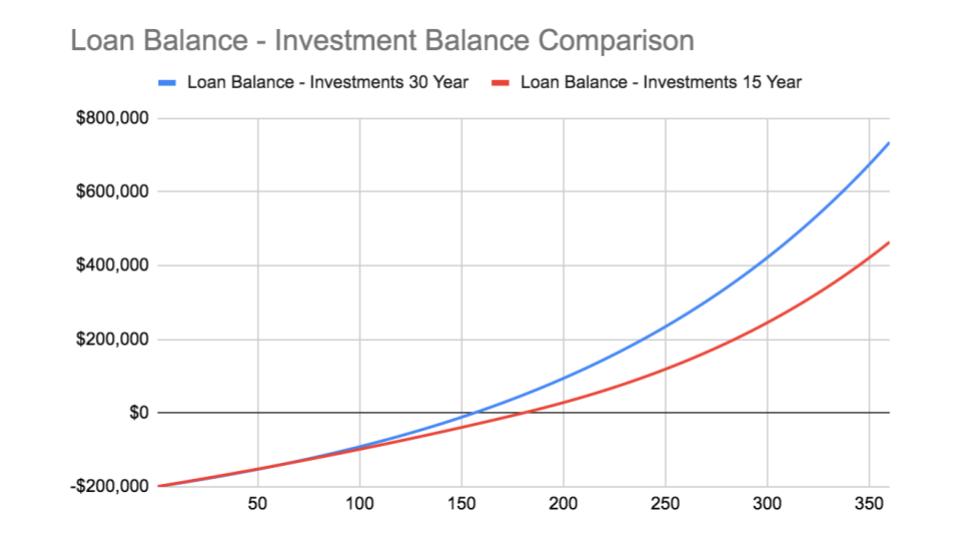
  • When you compare the Loan Balance – Investment Balance they are almost the same for 5-6 years, but the compound interest in the investment balance for the 30 year mortgage really takes off
Just so you know I practice what I preach I just refinanced from a 15 year to a 30 year at 2.625%.

Why?

  • I only pay $1,200 more a year in interest
  • With tax breaks that $1,200 is more like $936
  • The amount I am saving is being invested

The Daddy Interest Rate

The Daddy Interest Rate

Everyone that becomes wealthy, invests, and everyone who invests, first saves. One of the ways I teach and encourage my kids to save is through the “Daddy Interest Rate”

For every dollar they save in their savings account I give them 50%. So if they give me $10 for their savings account, I give them an additional $5.

I only have a few rules around using the money in their savings account.

  1. They have to save $1,000 in their bank accounts before they can withdraw any funds
  2. Their account balance has to always stay above $1,000

Why?

I want them to learn to have a buffer. Life is unpredictable, always have some cash, you may need it.

It is amazing how fast kids pick up on this! Here is what happened last year on one of my sons birthdays.

My dad, Pops to my kids, gives each one of them $100 dollars for their birthday to buy what they want. Usually we go to Target to pick something out together. Sometimes it is a few small things, other times something big, but it is THEIR CHOICE, they chose…

Last year, after a LOOONG time Target my youngest son who is 5, picked out a few small toys and said,

“Dad, I don’t need anymore toys, I want to bank the rest.”

I was so proud! On his own, with money in his hand, in front of rows of toys he decided to SAVE at FIVE!

This is something small any parent can do. Even if the Daddy or Mommy interest rate at your house is 10% or as much as 100% I guarantee your kids will get the message.

How do you teach money lessons to your kids?

How to SAVE on Property Taxes

How to SAVE on Property Taxes

You NEVER really own a piece of property. Try not paying Property Taxes and see what happens. Property Taxes are not going away. Let’s look at the Uncommon Way to pay and SAVE!

Why is this important?

Property taxes is one of the major expenses homeowners pay each year.

  • Estimating the Cost of Propriety Taxes According to the National Association of Realtors the median home purchase was $257K in 2019.
  • Property taxes in most locations are based on property’s values, so recent purchases give us a good idea how much most people are paying. Let’s use $250K to make math easy. Tax rates range from close to 0 to more than 2%

For simplicity let’s say 1%, so $2,500 per year. We are also going to assume we have to make payments to the government twice a year, so $1,250 in this example.

Idea 1: Fight the Man

Dispute the value of the property! I’ve done this twice and saved about $18K over the 10 years in my house

How?

  • Look at recent comparable sales in your area for the last 6-12 months based on number of bedrooms, bathrooms and square footage.
  • If you think your property is worth less than what the government says pay a few hundred to have a professional appraisal done. It’s easy for them argue against a homeowners analysis. They take a professional appraisal much more seriously.

Do the math to see if this makes sense.

Idea 2: Be smart in How you Pay

***Disclaimer***

You need a mortgage that DOES NOT escrow Taxes and Insurance. It’s best to do this when you first setup the loan. You can do it afterwards but you may have to pay a fee. You also need a healthy emergency fund.

Step 1) Instead of saving future payments in a savings account build an appreciating asset This could be

  • A taxable brokerage account of Index Funds or Dividend stocks
  • Real Estate
  • Cash Value Life Insurance

I would shy away doing this with volatile assets like

  • Crypto
  • Growth Stocks

Step 2) Take a loan out against the appreciating asset to pay the taxes. For this to work well the loan should be no more than 5% APY

Step3) Look to see how your government takes payments especially the credit and debit card processing fees. Pick the best payment mechanism for you and pay it!

Step 4) Pay back the loan over 6 months in full.

Example

  • Annual Property Taxes:
    • $2,500
    • Increases 3% every year
  • Asset:
    • 5% asset appreciation
    • 4% yield 5% dividend growth
  • Payment Mechanism:
    • M1 Spend debit card
      • 1% cash back
      • Processing fee $3.50
  • Loan Terms:
    • 2% APY Margin Loan paid monthly

Is this process more complex than having the mortgage company do it for you?

Absolutely!

But whether forced to save monthly through escrow or paying a monthly margin loan payment, you pay monthly!

And in 20 years time I’ll happily take $48K for a little complexity.

Arbitrage Investing Parenting real estate Saving Taxes